

 +7(495)150-11-22
  +7(800)250-87-00
  +7(499)110-40-67


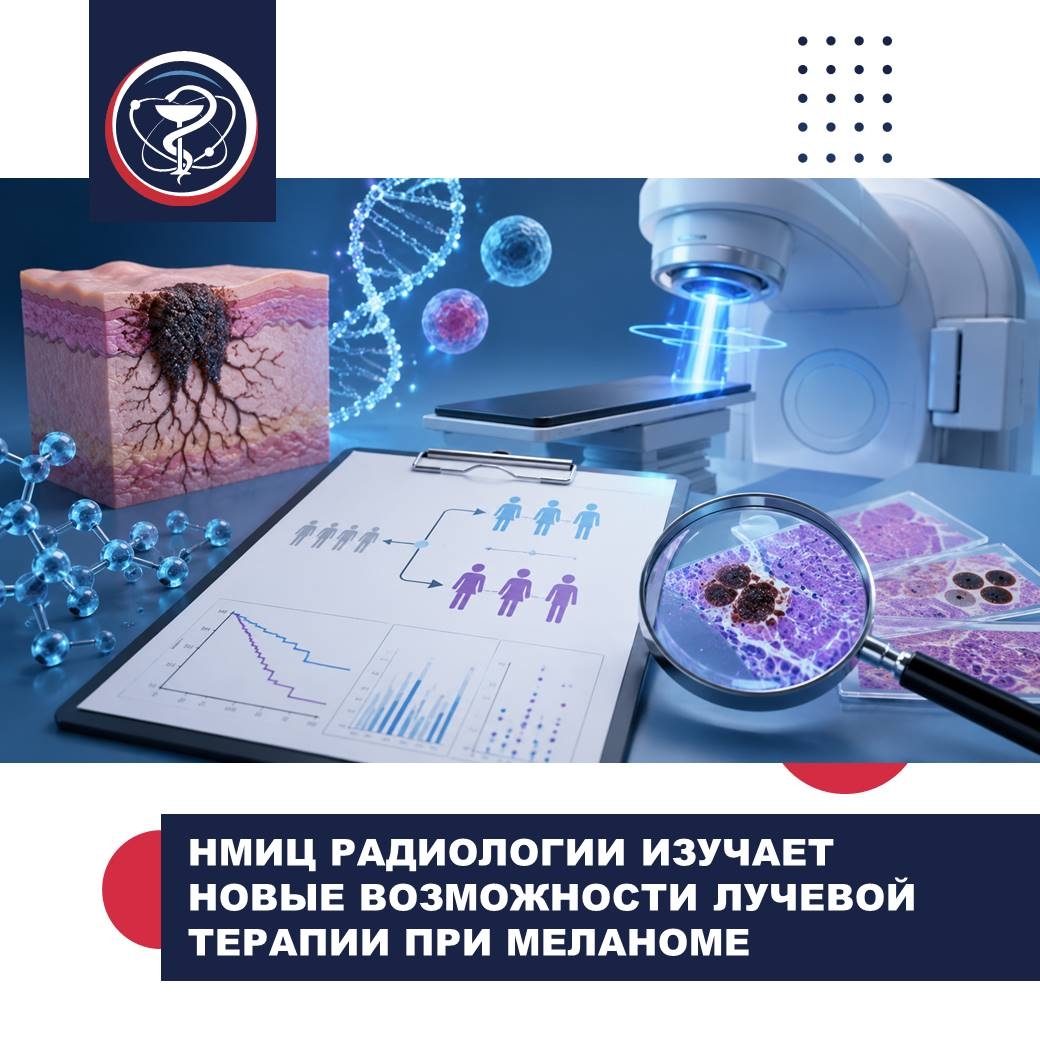




THE NATIONAL MEDICAL RESEARCH RADIOLOGICAL CENTER EXPLORES NEW POSSIBILITIES OF RADIATION THERAPY FOR MELANOMA
For a long time, melanoma was considered a tumor virtually insensitive to radiation therapy. This notion proved so persistent that even today some specialists approach this treatment with caution. However, modern radiation regimens are gradually changing this approach.
At the P. Hertsen Moscow Oncology Research Institute — a branch of the National Medical Research Radiological Centre of the Ministry of Health of Russian Federation — not only has extensive clinical experience in using radiation therapy for skin and mucosal melanoma been accumulated, but research is also underway to identify the most effective treatment regimens.
One of the research directions is a phase II randomized trial involving 50 patients with multiple brain metastases from melanoma and a poor prognosis. The patients were divided into two equal groups. The main group received an extreme hypofractionation regimen: the whole brain was irradiated in 4 sessions with a higher dose per procedure, instead of the standard 10 sessions.
The results were significant: 96 % of patients in the main group completed the full course, compared to 84 % in the control group. Intracerebral hemorrhage in a metastasis during treatment was recorded in one patient in the main group and in three patients in the control group. Moreover, the functional status of patients improved in the main group after therapy, while no significant changes were observed in the control group.
“Modern regimens allow us to take a fresh look at the role of radiation therapy in melanoma treatment. Our goal is not just to apply the technology, but to understand in which clinical situations it delivers the maximum effect”, – says Sergey Medvedev, PhD, leading research fellow at the Radiation Therapy Department.
One of the Center’s patients was 50‑year‑old Evgeny, who had metastatic melanoma with multiple brain lesions. The man was admitted to the federal center in severe condition: he suffered from seizures, dizziness, weakness, and pronounced motor impairments. After a course of whole‑brain irradiation followed by immunotherapy, the patient’s condition noticeably improved. Despite several disease progressions, he has been leading an active life for many years and has even experienced the joy of fatherhood for the fourth time.
Research continues. Currently, the National Medical Research Radiological Centre is conducting an open‑label, multicenter, pilot, prospective study of ultra‑hypofractionated radiation therapy in patients with inoperable, recurrent, and unresectable mucosal melanomas.
The specialists’ goal is to define the role of modern radiation therapy regimens in settings where this method was recently considered to have low efficacy, and to expand treatment options for complex patient groups.